Moving seat and door wiring harness routing should be defined against the vehicle program’s approved motion envelope. A route must remain controlled as the assembly moves, with clear requirements for fixed and moving endpoints, connector exits, retention and service access. Review the complete installed configuration and use customer-defined criteria for any required clearance, bend, slack or durability assessment.
Key takeaways
Map fixed and moving interfaces against the program-defined travel range and configuration.
Check harness path, retention, connector loading and nearby parts throughout required motion.
Use the vehicle program’s limits for bend, clearance, slack and validation; do not substitute generic values.
Review installation and service access as well as final static fit.
Record the revisions, positions checked, observations and open decisions.
What should the routing drawing show?
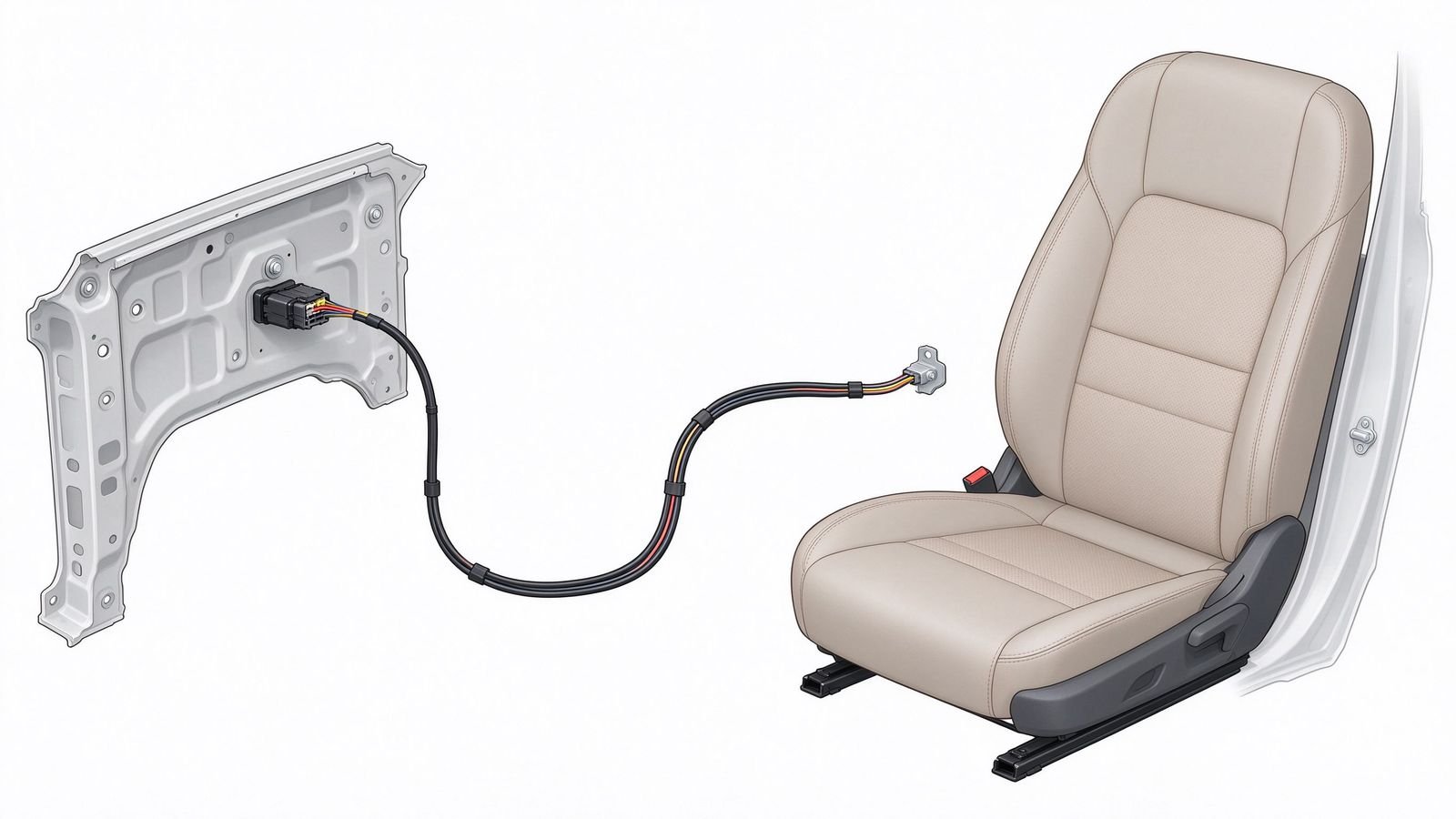
Provide an installation view that identifies the complete harness path, fixed and moving attachments, connector locations, clips or guides, protective transitions and customer-defined keep-out zones. State the positions to inspect and reference the source for travel and acceptance requirements. For a door route, show both body-side and door-side interfaces. For a seat route, show the path near the rail and explain how the intended retention behaves through travel.
Where a drawing does not establish the three-dimensional path, add a relevant section view or marked installation photograph from the controlled vehicle configuration. Identify nearby trim, brackets and components that constrain the route. Keep preliminary geometry visibly separate from released dimensions, so a supplier does not mistake an illustrative layout for an approved routing baseline.
JinHai’s automotive wiring harness page provides application context; the custom harness service page describes supplier scope. The customer drawing and vehicle program remain the controlling sources for geometry and acceptance criteria.
How should the motion envelope be mapped?
Identify what stays fixed and what moves, then review the route at the positions and transition states specified by the vehicle program. Fully open and closed positions may not reveal every concern; a branch can approach a bracket, edge or neighboring part during intermediate travel. Follow the full path from each fixed point to the moving endpoint and note where the harness bends, changes direction, passes a guide or enters a connector backshell.
Use the program’s motion definition and vehicle configuration rather than estimating travel from a single photograph. Confirm which seat, door, trim and hardware revisions are represented. If these inputs are not available, record them as open items. Do not invent bend radii, slack amounts, cycle counts or clearance limits when the program has not supplied them.
How should movement be reviewed on a representative assembly?
Install representative clips, brackets, trim and adjacent components before tracing the path through motion. Check the branch immediately behind each connector as well as the wider route. Look for tension, trapping, edge contact, abrasion exposure and interference with adjacent components. Confirm that clips stay engaged and connectors are not pulled or twisted by the moving assembly.
Before the check, record the seat or door configuration, harness revision, fixture or vehicle revision, positions to inspect and criteria supplied by the design authority. At each position, record what was observed and where. If the vehicle program requires a cycle or durability test, use its specified method and acceptance criteria; a visual fit review alone should not be described as that test.
When a route or retention feature changes, identify the affected positions and checks that need repeating. Link the finding and result to the updated drawing revision. The production process page provides manufacturing context, while the wiring harness quality page describes published inspection topics.
How should assembly and service access be reviewed?
A harness can fit after installation yet remain difficult to install or remove. Follow the intended assembly sequence and note if a branch must be twisted, compressed or held under load to mate a connector. Record whether a clip or guide becomes inaccessible after trim installation, and whether a connector latch can be reached without pulling on conductors.
For service, identify the position that lets a technician reach the intended interface and release it as designed. Check whether the service action disturbs another branch, harness or moving part. Document the retention parts that must be restored after access and the intended replacement boundary. Do not assume that every branch should be disconnected or repaired in the vehicle; the approved service design should define which interfaces are serviceable.
Review slack and retention as a system. More slack is not automatically safer: an uncontrolled loop may rub, snag or enter another component’s movement path. Too little slack can load a terminal or connector as the assembly moves. The route owner should define the intended path, retention points and acceptance criteria, then verify those decisions on a representative vehicle or fixture.
How should routing observations be closed?
For each concern, note the harness and drawing revision, vehicle or fixture configuration, motion state, location and observed condition. Distinguish direct observation from a possible risk or suggested improvement. For example, record contact with a trim edge at a specified position before concluding that a clip must move. Assign an owner, disposition and status so the review record shows whether the item blocks approval.
When rail geometry, hinge position, trim, connector location or retention changes, perform an impact review before carrying forward earlier approval. The design authority should decide whether movement, fit, electrical, service or durability checks need repeating. Update the controlled drawing and relevant review records together. For a project review, send controlled route views and customer requirements through the project inquiry page.
What should an RFQ or design review include?
Share the current harness drawing, installation view, connector details, movement information and acceptance criteria. Identify the applicable seat or door configuration and list the vehicle, fixture and harness revisions. Include installation sequence and service access constraints when they influence routing. If travel limits, environmental exposure or validation requirements are not defined, label them as open items rather than asking suppliers to assume a universal value.
Ask bidders to separate confirmed requirements from proposed construction choices and quotation assumptions. A supplier may identify a potential conflict or recommend a route for review, but the vehicle design authority remains responsible for accepting geometry and program requirements. When a drawing changes during sourcing, issue the current revision and identify which quotation or sample decisions need to be revisited.
Moving harness routing review checklist
Identify fixed and moving endpoints and the controlling motion definition.
Show the complete route, connector exits, guides, protection and retention points.
Check contact, pinching, tension and interference at the required positions.
Review assembly sequence and service access with representative adjacent parts installed.
Record configuration, revisions, criteria, observations, owners and open items.
Define the impact review and repeat checks when the route or vehicle geometry changes.
Frequently asked questions
Can a static sample prove movement suitability?
No single static position proves performance through travel. Check the positions and method required by the vehicle program, including transitions or tests where specified.
Should more slack always be added?
No. Slack should follow the intended movement and retention design. Excess slack can create a snag or contact risk, while insufficient slack can load a connector or conductor.
Who sets the bend, clearance and cycle limits?
The vehicle program or responsible design authority should provide the applicable requirements and acceptance method. Treat missing values as open inputs until confirmed.
What evidence should be kept after a routing review?
Record the sample and vehicle revisions, positions checked, supplied criteria, observations, decisions and closure status. Include cycle or durability results only when the required method was performed and its results are available.


 Español
 العربية
 Bahasa Indonesia
 Tiếng Việt




 English
 Vietnamese
 Indonesian
 Arabic
 Spanish