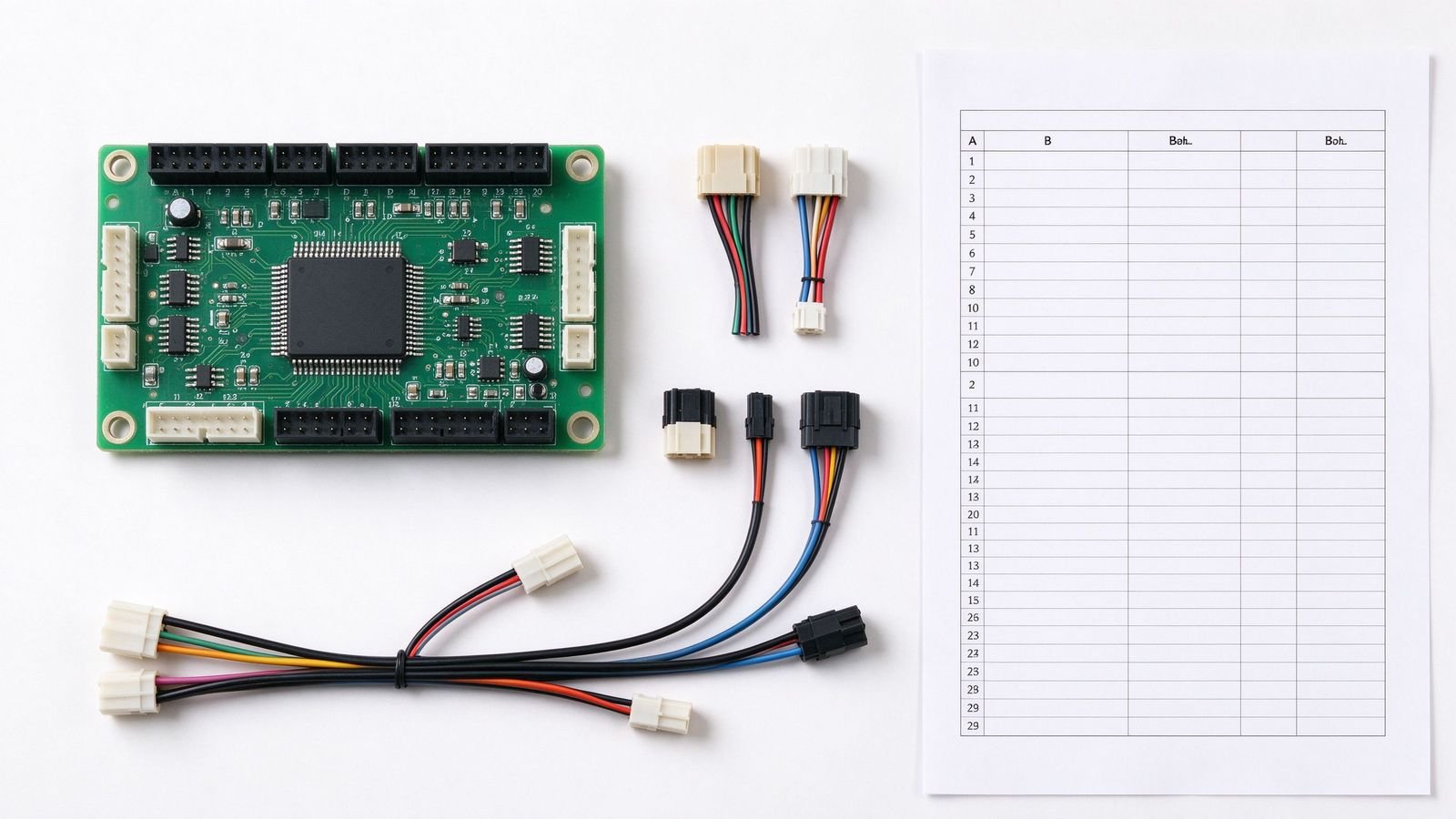
A smart appliance wire harness design handoff should connect the control-board pinout, bill of materials (BOM), and physical appliance layout. The drawing, circuit definition, connector data and installation route must describe the same revision. This gives engineering, sourcing and the harness supplier a reviewable package without turning an unconfirmed requirement into a quotation assumption.
Key takeaways
Link the harness drawing, circuit list, connector cavity map and BOM by revision.
Show the appliance route, connector orientation, retention points and installation direction.
Identify owner-supplied operating, compliance and test requirements; leave unknown values open.
Review the prototype in its intended enclosure or a representative fixture.
Record deviations, owners, dispositions and the revision that closes each item.
Which files should an appliance harness package include?
Start with a released or clearly marked preliminary harness drawing. Include views that make branch destinations, breakout locations and connector exits unambiguous, plus the appliance or board layout that defines the installation space. A flat harness drawing and an enclosure drawing answer different questions; the handoff should let a reviewer connect them without reconstructing the route from a schematic.
The circuit list should identify each circuit’s source, destination, connector, cavity and wire reference. Show cavity orientation from a named mating face or view, and identify spare cavities. Include connector part numbers and approved alternatives where available. If the board connector is not selected, record it as an open decision rather than allowing a quotation assumption to become an unnoticed design baseline.
The BOM should correspond to the same harness revision as the drawing. Give each line a stable reference and identify which items are customer-specified and which remain supplier proposals. Where a specification, material or compliance requirement has not been supplied, state that it is pending confirmation. Do not infer temperature, moisture, chemical exposure, lifetime or regulatory limits from the appliance category.
Also identify the files that control labels, packaging, electrical inspection and workmanship review. These items often sit outside the drawing but still affect what a supplier builds and what the buyer accepts. JinHai’s consumer electronics harness page provides application context, and the production process can help teams discuss how a sample will be assembled and inspected.
How should ownership and open requirements be handled?
Mark the owner for every requirement that is not fully defined. The appliance design authority may own the board interface, the product team may own enclosure and service constraints, and purchasing may own commercial documents. The supplier can identify a conflict or propose an option, but the proposal should remain open until the responsible owner confirms it.
Keep a short open-item register with the question, affected drawing or BOM line, responsible person, decision needed and target revision. A clear status such as pending, proposed, accepted or rejected is more useful than a note that simply says “check later.” When a requirement changes, update the register and the affected controlled files together so a sample does not get reviewed against an obsolete assumption.
How should electrical interface and physical fit be reviewed?
Check the electrical definition and installation definition as separate workstreams, then reconcile them at the physical sample. For the interface review, compare board revision, connector part number, keying, cavity view, circuit function, polarity where applicable and harness drawing. Do not rely on connector shell similarity to establish compatibility.
For physical fit, review the appliance envelope, branch destinations, mating direction, retention points, nearby moving parts and service-panel access. Show the planned assembly direction and the sequence for installing adjacent components. A route that fits only when a branch is twisted or pulled into place is a useful review finding: document it and ask the design owner to resolve whether the drawing, retention feature or installation sequence needs revision.
Before signoff, confirm the exact appliance, board and harness revisions used in the check. If the enclosure is still changing, mark the review as provisional and list which interfaces may be affected. A previous sample approval should not automatically carry forward when a board connector, cavity assignment, branch route or mounting feature changes.
What should be checked during a prototype or sample review?
Agree on the acceptance basis before the sample arrives. Identify who supplies the test requirements, which drawing revisions govern inspection, how findings are recorded and who can approve a deviation. If customer-specific tests or limits have not been provided, list them as pending; do not substitute generic pass/fail values.
Review the sample in the intended appliance or a fixture that represents the relevant interfaces. Confirm that the connector can be identified, oriented and mated in the planned sequence. Check that branches reach their destinations without forcing conductors, that retention features can be restored, and that nearby covers, panels or moving parts do not create an unreviewed interference. Record the actual configuration used, including board, enclosure and harness revisions.
A practical review record can capture the sample identifier, fixture or appliance configuration, inspection date, checks performed, open findings, responsible owner, due point and disposition. Separate observations from approved changes. For example, “connector access is obstructed in the shown assembly sequence” is an observation; a changed connector orientation is a design decision that requires approval and updated controlled files.
Use the same record to close findings. Mark each item accepted, corrected and rechecked, or still open. If a correction changes the drawing or BOM, confirm that the sample and document set being approved match the updated revision. This keeps a prototype review useful to both engineering and purchasing without presenting an informal fit check as full product validation.
How should board or enclosure changes be controlled?
When a board revision changes, compare the connector interface and circuit assignments against the prior release. When an enclosure revision changes, review routes, branch lengths, retention, mating access and assembly sequence. A change that appears local may affect neighboring branches or service access, so record the affected interfaces and the reason for the assessment.
The change record should identify the old and new revisions, description of change, affected parts and documents, effectivity decision, sample or verification needed and approval owner. Keep the harness drawing, BOM, circuit list, label content and test instructions aligned. If the change has no effect on a particular item, record the review basis rather than silently carrying the old approval forward.
What should be ready before a supplier builds the sample?
The supplier should be able to identify the governing harness revision, the applicable board and enclosure revisions, the intended assembly sequence and the unresolved decisions. Provide the latest drawing set in a controlled location, with obsolete files clearly separated. If alternative connectors, wire constructions or protective parts are still being evaluated, label them as proposals and explain what decision will select the final item.
Confirm how the sample will be identified and how changes will be communicated. A part label, drawing revision and sample record should point to the same configuration. When the buyer expects a quotation before the package is complete, ask the supplier to list assumptions and exclusions explicitly. This keeps an early budgetary response separate from a released production baseline.
Appliance wire harness handoff checklist
Appliance model, board, harness and drawing revision are identified.
Circuit list, connector cavity views and BOM refer to the same configuration.
Route, branch destinations, exits, retainers and installation sequence are shown.
Owner-supplied operating, compliance and test requirements are attached or listed as open.
Open decisions have owners and a recorded disposition path.
Sample acceptance checks, evidence, deviation authority and closure owner are agreed.
Changes have an effectivity decision and identify required sample or document updates.
Frequently asked questions
Is a board schematic enough to request a quote?
It explains circuit intent but usually does not define the complete harness route, connector orientation, retention, appliance fit or installation sequence. Provide the schematic with a controlled harness or appliance layout and clearly mark unresolved interfaces.
What if the enclosure is still changing?
Mark the layout preliminary, identify the dimensions and interfaces that may change, and agree which sample checks remain provisional. Revisit affected routing and fit when the controlled enclosure revision is available.
Should the supplier choose a wire rating or environmental limit?
The product owner or design authority should provide the applicable requirements. A supplier may submit a proposal for review, but it should not become the approved baseline until the responsible owner confirms it.
What evidence should accompany approval?
Record the sample and document revisions, checks performed, observations, open deviations, decisions and closure status. Include test results only when the agreed method and acceptance criteria are defined and the results are available.


 Español
 العربية
 Bahasa Indonesia
 Tiếng Việt




 English
 Vietnamese
 Indonesian
 Arabic
 Spanish