Chapter 1: What Is Kapton Tape?
Product Overview:
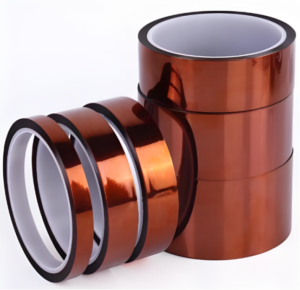
Kapton tape is a high-performance composite tape manufactured by coating a polyimide substrate with a special pressure-sensitive adhesive. Polyimide film offers excellent thermal stability, high dielectric strength, and low outgassing characteristics. The substrate itself can withstand continuous temperatures ranging from -73°C to 260°C, with short-term peaks exceeding 300°C. With typical thicknesses ranging from 0.025 mm to 0.075 mm, it is one of the thinnest insulating materials in the industry.
Core Value Proposition:
Kapton tape has set the industry standard across three core dimensions: “high-temperature resistance, insulation reliability, and residue-free removal.” While traditional tapes fail in high-temperature reflow soldering or chemical cleaning environments, Kapton tape maintains stable performance and can be removed without leaving any residue after the process is complete, ensuring compliance with clean process requirements.
Core Features at a Glance
| Performance Parameter | Typical Value | Description |
| Continuous Operating Temperature | -73°C to 260°C (-100°F to 500°F) | Excellent substrate thermal stability |
| Short-Term Peak Temperature | Over 300°C | Suitable for processes such as reflow soldering |
| Dielectric Strength | 6,500V to 10,000V | Depends on thickness; meets UL certification requirements |
| Tensile Strength | 33 lb/in (approx. 46 N/cm) | Adequate holding force |
| Flame Retardancy Rating | UL 510 certified | Meets electrical safety standards |
| Outgassing Rate | Extremely low | Suitable for vacuum environments |
Chapter 2: Advantages of Choosing Kapton Tape
Material Analysis:
The core advantages of Kapton tape stem from the high-bond-energy structure of the polyimide molecular chains. This structure endows the substrate with three key properties: maintaining physical integrity without melting under continuous high temperatures of 260°C; a volume resistivity as high as 10¹⁶ to 10¹⁷ Ω·cm; and a dielectric constant stable at 3.4 to 3.6 (1 MHz); as well as excellent solvent resistance and chemical corrosion resistance.
Silicone pressure-sensitive adhesive (Silicone PSA) combined with the polyimide substrate ensures that the tape maintains its adhesion at high temperatures and leaves no residue upon removal. Kapton tape is also self-extinguishing; even if ignited, it quickly self-extinguishes with only surface charring, making it safer than many alternatives.
What are the advantages of Kapton tape compared to ordinary tapes? As shown in the table below:
| Performance Parameter | Kapton (Polyimide/PI) | PVC Tape | PET Cloth-Backed Tape |
| Long-term operating temperature | 220–260°C | ≤80°C | 80–120°C |
| Short-term peak temperature | Above 300°C | 100–130°C | 150–200°C |
| Volume resistivity (Ω·cm) | 10¹⁶–10¹⁷ | 10¹²–10¹⁴ | 10¹⁴–10¹⁵ |
| Dielectric strength (kV/mm) | 100–300 | 20–50 | 50–100 |
| Flame retardancy rating | UL 510 certified | Flame retardant (low grade) | Partially flame retardant |
| Chemical resistance | Excellent (acid and solvent resistant) | Fair | Good |
| High-Temperature Residue-Free | Yes | No (Significant Residue) | Available for Some Products |
| Cost Tier | High | Low | Medium |
Chapter 3: How to Select the Right Kapton Tape?
Core Parameters:
- Film Thickness: Typically 1 mil (0.025 mm), 2 mil (0.050 mm), or 3 mil (0.075 mm), which directly affects dielectric strength and mechanical strength.
- Adhesive Type: Primarily silicone and acrylic. Silicone adhesives withstand temperatures ranging from -40°C to 260°C and are the preferred choice for high-temperature applications; acrylic adhesives have an upper operating temperature limit of approximately 177°C.
- Dielectric Strength: Typical values range from 6,500V to 10,000V, increasing with thickness.
- Certification: Verify whether the product has passed UL 510 flame retardant certification and the MIL-P-46112B military standard.
Selection Guide:
| Application | Recommended Parameter Combination |
| PCB Reflow Soldering Masking (Lead-Free) | Silicone adhesive, substrate thickness 25–50 μm, dielectric strength ≥6 kV |
| Wave Soldering Masking | Silicone adhesive, substrate thickness ≥50 μm |
| Gold Finger Protection | Ultra-thin (0.025–0.050 mm) type, ensuring no residue |
| High-Voltage Electrical Insulation | Thicker substrate (≥0.075 mm), dielectric strength ≥9 kV |
| Vacuum/Aerospace Applications | Silicone adhesive, ASTM E595 outgassing test report required |
| Double-Sided Bonding (Wire Harness Fixation, etc.) | Double-sided coated type, total thickness 0.1–0.2 mm, bond strength ≥5 N/25 mm |
Customization Options:
- Kapton tape supports a variety of customization options:
- Single-sided or double-sided coating
- Precision die-cutting
- Anti-static (ESD) versions and black opaque versions
- Specifications with release liner for automated application.
Chapter 4: Summary
Thanks to its unique polyimide molecular structure, Kapton tape offers thermal stability, dielectric strength, and chemical resistance that other tape materials cannot match. From PCB reflow soldering masking to spacecraft wiring harness protection, and from high-temperature insulation to double-sided mounting, Kapton tape has become the benchmark material for demanding electrical and industrial applications.
Since different application scenarios vary in terms of temperature profiles, adhesive types, and removal requirements, we recommend contacting JinHai’s technical team for specific selection advice and requesting samples for small-batch validation to ensure the selected specifications perfectly match your production process.