Once ordinary commercial-grade cables are deployed in robotic arms, CNC machines, or heavy-duty drag chains, they are highly susceptible to insulation cracking or internal wire breaks due to daily physical friction and chemical erosion.
As a specialized manufacturer with deep expertise in precision connectivity, JinHai has discovered through collaboration with numerous automation equipment R&D teams that true industrial-grade reliability does not come from randomly selecting a standard cable from a product catalog, but rather from “Highly Flexible Industrial Automation Wiring Harnesses Customization” tailored to specific harsh operating conditions.
This article will provide an in-depth analysis from multiple perspectives—including mechanical fatigue, materials science, electromagnetic compatibility, and engineering prototyping—to explain how scientifically tailored cable harnesses can build an indestructible “nervous system” for your industrial automation equipment.
The Invisible Killer in Industrial Settings: Why Do Your Standard Cable Harnesses Keep Failing?
To design a perfect industrial cable harness, the first step is to confront the harsh physical environment in which it operates. Unlike static wiring, wiring harnesses in automated equipment have a “life” of their own; they move continuously with every operation of the machine.
This dynamic environment poses three major challenges for highly flexible industrial automation wiring harnesses:
First is persistent mechanical fatigue.
- In the multi-axis movements of industrial robots or the long-distance drag chains of gantry milling machines, wiring harnesses must endure millions—or even tens of millions—of U-bends and high-intensity torsion.
- Standard PVC (polyvinyl chloride) cables will see their internal copper wires gradually fracture due to metal fatigue after tens of thousands of bends, leading to intermittent contact issues.
- These “soft faults” are extremely difficult to diagnose and often cause significant headaches for maintenance personnel.
Second is complex chemical and environmental corrosion.
- Industrial workshops are certainly not cleanrooms.
- Splashing cutting fluids, pervasive industrial lubricants, high-temperature metal debris, and corrosive solvents used to clean equipment can all cause severe damage to the cable’s outer sheath.
- Once ordinary sheathing absorbs oil and grease, it swells, losing its insulating properties and creating a potential hazard for short circuits and fires.
Finally, there is the harsh electromagnetic interference (EMI) environment.
- Modern automated equipment integrates a large number of variable-frequency drives, high-power motors, and high-frequency switching power supplies, all of which emit intense electromagnetic noise during operation.
- If cable harnesses transmitting weak control signals (such as encoder signals or analog sensor data) lack professional shielding design, data distortion will occur, directly leading to robotic arm misalignment or reduced machining accuracy.
Customization: Decoding the Materials and Structures of Highly Flexible Industrial Automation Wiring Harnesses
To address these challenges, JinHai’s engineering team begins with the most fundamental level—materials and structure—when customizing industrial cable assemblies, implementing a systematic “Design for Manufacturing” (DFM) approach.
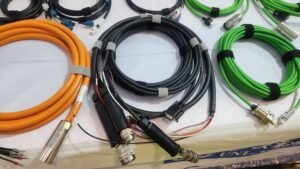
- Taking Sheath Materials to the Next Level: The PUR vs. TPE Showdown When it comes to withstanding oil, abrasion, and extreme temperatures, the choice of material determines the maximum lifespan of a cable assembly. For custom cable assemblies intended for use in drag chain systems or exposed to cutting fluids, we typically eschew traditional PVC in favor of PUR (polyurethane) or high-performance TPE (thermoplastic elastomer) for the outer sheath. PUR not only offers exceptional tear strength and abrasion resistance but is also immune to the vast majority of industrial acids, alkalis, and engine oils. Even in low-temperature environments, it retains excellent flexibility, ensuring the smooth operation of drag chain systems.
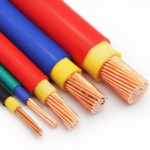
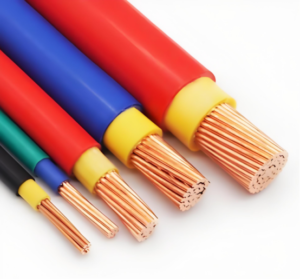
- Redesigned Strand Structure and Conductors To withstand millions of dynamic bends, the internal structure of the conductors must be specially engineered. We use extremely fine oxygen-free bare copper or tinned copper wires for high-density stranding, rather than a single thick copper wire. Additionally, in the cabling process for multi-core cables, we incorporate bulletproof fibers (such as Kevlar) as a tensile-resistant core filler. When the cable harness is subjected to severe pulling, the stress is concentrated on the strong fibers, thereby completely protecting the fragile copper conductors from damage caused by tensile stress.
- Building an Electromagnetic Shielding “Armor” In the customization of signal harnesses, the shielding process is of paramount importance. For mixed interference in industrial environments, a single layer of aluminum foil is no longer sufficient. JinHai employs a dual-shielding solution of “aluminum foil + high-density tinned copper mesh braiding,” with the braiding coverage strictly controlled at over 85%. For extremely high-frequency interference, we also incorporate a twisted-pair (Twisted Pair) structure. This design allows the two signal lines to cancel out surrounding electromagnetic noise, ensuring that every frame of industrial Ethernet data or sensor signal reaches the control center cleanly and stably.
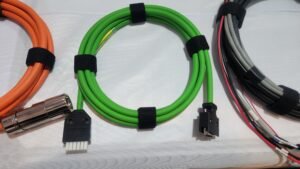
Custom Highly Flexible Industrial Automation Wiring Harnesses: Eliminating Hidden Defects Through Craftsmanship and Standards
Even the most outstanding design drawings are nothing more than a castle in the air without rigorous manufacturing processes to support them. The assembly process for industrial wiring harnesses involves numerous steps, including wire stripping, crimping, soldering, and injection molding. Any minor deviation in the process could become the trigger for future production line downtime.
Within JinHai’s production system, we strictly adhere to IPC/WHMA-A-620, the globally recognized manufacturing standard for cables and wiring harnesses. Take the critical process of terminal crimping as an example—this is by no means a simple matter of squeezing metal together with pliers. We precisely set the crimp height and width for different wire gauges and terminal types. Through high-precision cross-sectional analysis, we ensure that a cold-welding effect occurs within the terminal, achieving optimal mechanical tensile strength and extremely low contact resistance.
Additionally, to meet waterproof and dustproof requirements in harsh environments, we employ a professional overmolding process at the connector’s tail end. Compared to traditional heat-shrink tubing, the overmolding process not only provides an absolute seal up to IP67/IP68 ratings but also creates an excellent strain relief structure, completely eliminating cable breakage at the connector base caused by frequent movement.
To keep the defect rate at zero, we make no compromises in the inspection process. JinHai has abandoned the industry’s common spot-checking model and insists on conducting 100% comprehensive electrical testing on every custom cable assembly before shipment. This includes millisecond-level continuity testing, insulation resistance testing, and high-voltage withstand testing (Hipot Test) using automated testers, ensuring that every cable delivered to the customer is plug-and-play and flawless.
Highly Flexible Industrial Automation Wiring Harnesses: Why Are Low Minimum Order Quantities (Low MOQ) Critical for Engineers?
In our discussions with numerous smart equipment startups and large-scale equipment R&D departments, the most common complaint we hear is not technical difficulty, but rather the R&D hurdles caused by the supply chain.
When a brand-new, non-standard automation project is in the prototype testing phase, engineers typically need only 5 to 10 custom cable assemblies to verify electrical logic and wiring routes. However, faced with such small-volume demands, traditional large-scale cable manufacturers often immediately impose exorbitant minimum order quantities (MOQs) in the thousands or quote delivery lead times spanning several months. This forces engineers to painstakingly craft temporary harnesses by hand in their labs using crimping pliers. These handmade harnesses, lacking quality control, are highly prone to causing all sorts of bizarre faults and interference during testing. Not only does this waste precious R&D time, but it also severely compromises the accuracy of test data.
JinHai deeply understands this engineering pain point. We firmly believe that every great industrial innovation begins with “small batches.” Therefore, we have established a dedicated agile prototyping fast track for R&D teams, committed to providing genuine low minimum order quantity (Low MOQ) support. Whether you need a single prototype or a small-batch trial run of 100 units, our engineering team will provide one-on-one DFM assistance. Leveraging our extensive supply chain expertise and ample inventory of common connectors—such as M8/M12 sensor interfaces and heavy-duty connectors frequently used in industrial applications—we can deliver test samples meeting mass-production standards to your laboratory in as little as 3–5 business days.
This seamless engineering support completely eliminates supply chain bottlenecks in the early stages of R&D, helping your automation equipment iterate at the fastest possible pace and seize market opportunities.
Conclusion: Entrust Your Connectivity Solutions to a True Engineering Partner
In the era of Industry 4.0, system complexity is rising exponentially, and any vulnerability in a single connection can become the Achilles’ heel of an entire smart factory. Highly flexible industrial automation harnesses are not merely physical conduits for transmitting current and signals; they are the core link ensuring continuous, stable, and efficient equipment operation.
Faced with severe bending challenges, harsh chemical environments, and complex electromagnetic interference, choosing a professional custom solution is no longer a bonus—it is a necessity. JinHai Wiring Harnesses is committed to being the manufacturing partner trusted by engineers worldwide. We not only provide exceptional cable assemblies but also deliver professional engineering insights and proven manufacturing capabilities.
Don’t let unreliable wiring become the weak link in your state-of-the-art equipment. If you’re seeking durable, compliant, and responsive industrial wiring harness solutions for your next-generation smart devices, contact the JinHai team today. Let us connect you to a more stable and efficient automated future through our professional customization expertise.