Chapter 1: What Constitutes a Wire Harness Connector?
A complete wire harness connector primarily consists of two core components: conductive elements and insulators.
- Conductive elements, or metal terminals, facilitate current flow.
- Insulators, or the connector housing, provide electrical insulation, mechanical support, and environmental protection. The raw materials forming connectors exhibit strong plasticity. Before processing, these materials exist as minute granular particles, hence termed “granules” or “plastic pellets” in industrial contexts.
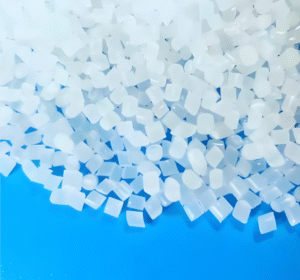
Particle material for forming connectors
As the raw form of various engineering plastics, their high plasticity allows them to be molded into the diverse shapes and colors of connector housings through injection molding. Thus, granules confer temperature resistance, flame retardancy, mechanical strength, and chemical stability to connectors.
Chapter 2: How Are Granules for Wire Harness Connectors Categorized?
Granules come in diverse varieties. Within the connector industry, they are primarily distinguished based on the chemical properties of their base resin and the modified additives incorporated. They can be broadly classified into two categories:
1.General-purpose engineering plastics:such as polyamide (PA, commonly known as nylon), particularly PA66. Due to its excellent processability and cost advantages, it is widely used in standard automotive interior connectors. To enhance thermal resistance or flame retardancy, manufacturers modify these materials by adding glass fiber or flame retardants, resulting in commonly referenced variants like “reinforced PA” or “flame-retardant PA.”
2.High-performance specialty engineering plastics:These materials are essential when operating environments become demanding, such as withstanding high temperatures in engine compartments or high voltages in new energy vehicles. Typical examples include:
- Polysulfone (PPS): A highly heat-resistant and flame-retardant material capable of sustained operation above 200°C. Commonly used for surface-mount connectors requiring reflow soldering, automotive lamp sockets, and high-temperature electrical enclosures.
- Polyphthalamide (PPA): Also known as high-temperature nylon, Beyond high-temperature resistance, it offers excellent dimensional stability and chemical resistance, making it ideal for thin-walled high-voltage connectors.
- Liquid Crystal Polymer((LCP): Characterized by exceptional flow properties, high stiffness, and minimal linear expansion coefficient, enabling precise molding of intricate structures. It is an ideal material for high-frequency connectors.
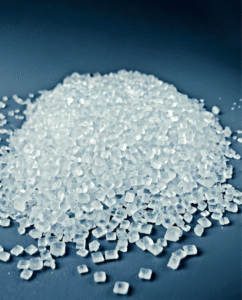
LCP compound for manufacturing connectors
The key to distinguishing these pellets lies in examining their material property sheets. These sheets clearly specify the base polymer type (e.g., PPS, PA9T), filler content ratio (e.g., “60% glass-filled reinforcement” indicates 60% glass fiber addition), and critical thermal performance metrics (e.g., heat deflection temperature, UL-94 flame retardancy rating).
Chapter 3: How to Identify Connector Applications in Vehicles Based on Different Pellet Grades?
In practical applications, we can determine the required resin grade based on the connector’s appearance, color, and its location within the vehicle.
1.Engine Compartment and Transmission Area (High-Temperature, Oil-Contaminated Environments)
Connectors used in this zone—such as those for engine control units (ECUs), fuel injectors, and oil pressure sensors—must employ highly heat-resistant materials like PPS or PPA. These materials typically exhibit darker hues (e.g., black or dark gray) and a harder tactile feel.
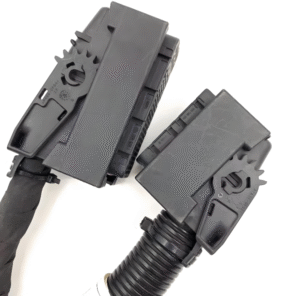
Connector connected to the ECU
2.High-voltage systems(in new energy vehicles (high current, high voltage, stringent safety requirements)
Connectors in this area—such as those for inverters, DC-DC converters, and orange high-voltage connectors within battery packs—usually employ halogen-free flame-retardant PPA materials. This material not only withstands higher voltages and temperatures but also effectively prevents electrolytic corrosion, ensuring high-voltage safety.

Orange high-voltage wiring harness connector
3.Vehicle Interior and Conventional Wiring Harnesses (Normal Environments)
Connectors in these areas, such as those for door control modules, audio systems, and interior lighting assemblies, are typically made from PA66 or PBT materials reinforced with 30% fibers. They are predominantly black or off-white, primarily meeting standard mechanical performance and cost requirements.
Chapter 4: What Risks Arise from Using Connectors Manufactured with Mixed Particle Materials?
During maintenance or production, disregarding grade differences in particle materials and arbitrarily mixing or substituting materials can create serious safety hazards. Specific risks include:
Thermal deformation and contact failure:
This is the most immediate risk. Standard nylon materials with lower heat resistance can soften and deform within the high-temperature engine compartment, compromising the locking mechanism between the connector housing and internal terminals. This leads to poor contact, terminal dislodgement, and potential circuit interruption.
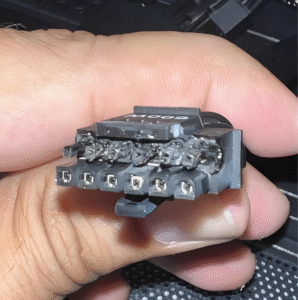
Connector deformed and melted due to heat
Combustion and Fire:
Electrical connection points inherently generate heat. If materials lack the required UL94 V-0 flame retardancy rating, increased contact resistance or overload heating may cause the connector itself to become a “combustion accelerant.” Especially in high-voltage environments, halogen-free flame-retardant materials must be used; otherwise, combustion will produce large amounts of toxic smoke.
Electrochemical Corrosion:
Compared to PPA-based materials, standard nylon exhibits higher moisture absorption. If mixed materials are used, the connector cannot effectively block moisture. This moisture, combined with metal terminals and the presence of an electric field, readily triggers terminal electrolytic corrosion, compromising the entire system’s corrosion resistance design.
Dimensional Instability Causing Assembly Difficulties:
Different materials have varying molding shrinkage rates. Mixed particle materials often result in poor mating with counterpart connectors or equipment housings, causing “looseness” or “insertion failure.”

Connector that cannot be mated due to incorrect dimensions
Brittle fracture:
While high glass-fiber reinforced materials offer high strength, their toughness decreases. Failure to balance this or substituting high-strength materials for tough ones can cause snap-fit clips to fracture brittlely during installation, preventing proper connector locking.
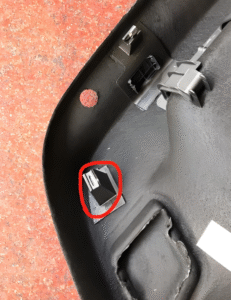
Brittle fracture of connector latches
Chapter 5: Conclusion
In summary, the performance of wire harness connectors is fundamentally rooted in their raw material—the resin compound.
In today’s era of increasingly complex vehicle electrical systems and the high-voltage evolution of new energy vehicles, accurately identifying and strictly selecting specified grades of compound material is not only critical for equipment operation but also serves as the final line of defense for ensuring overall vehicle safety and reliability. At JinHai, our design team provides you with the highest quality design solutions, ensuring you receive safe, reliable products that help your projects succeed safely and efficiently.